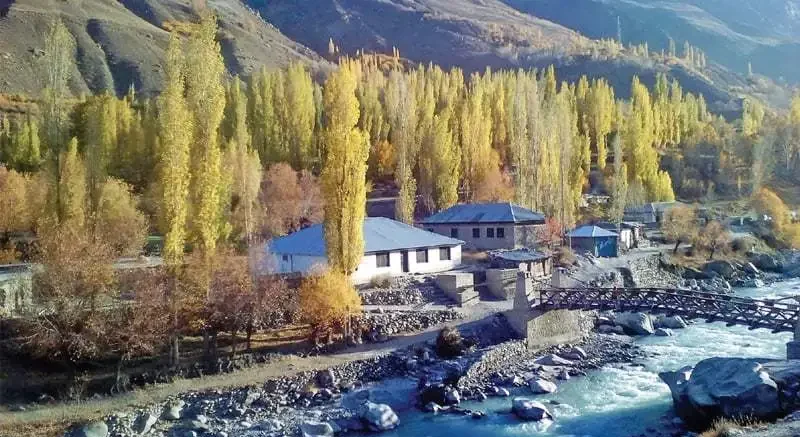
Chitral is one of the most beautiful places in Pakistan, with its towering snow-covered mountains, rivers, charming valleys, waterfalls, springs, and lush, fruit-bearing, and tall trees that captivate tourists with their allure. Chitral is located in the far north of Pakistan, nestled at the foothills of Tirich Mir, the highest peak of the Hindu Kush mountain range, which separates it from the countries of Central Asia. This part of the state was later granted the status of a district and connected to the Malakand Division of Khyber Pakhtunkhwa province. It is the largest district in the province in terms of area.
Due to its unique geographical location, this district remains disconnected from other parts of the country for about five months each year. Chitral’s distinct identity, with its attractive culture and mysterious past, has gained significant importance in terms of tourism. In the present day, the independence of Central Asian Muslim countries has further highlighted its significance.

There are two ways to travel to Chitral: by air and by road. Flights between Islamabad and Chitral are operated twice a week, on Fridays and Sundays, by the national airline PIA. Similarly, there are flights from Peshawar to Chitral on Fridays and Sundays. In addition, tourists and locals also travel to Chitral by road. The distance between Islamabad and Chitral is 437 kilometers, and it takes about five and a half hours. During this journey, when departing from Islamabad, you first pass through Peshawar while traveling on the motorway. Then, after crossing Malakand, you reach Chitral. Likewise, travelers can also take the road from Peshawar to Chitral. Compared to Islamabad, the road journey from Peshawar to Chitral is easier. As soon as you move ahead from Peshawar, the breathtaking landscapes begin to unfold. After crossing Malakand, the Chitral River starts captivating tourists with its stunning beauty, and they continuously take photos and videos with their mobile phones.

The beautiful city of Chitral has several hotels and rest houses, in addition to the PTDC motel, which offers all kinds of facilities. While the entire Chitral is blessed with natural beauty, the peak of Tirich Mir stands out. It is the highest peak in the Hindu Kush mountain range, rising over 25,000 feet above sea level. There is no need to climb this peak while touring Chitral, as the sunrise and sunset views from there captivate visitors with their charm.
Every region has its unique culture and history, which is preserved in various forms. Similarly, the Chitral Museum holds many stories of the past. It was built on July 8, 2010, with the primary goal of introducing tourists to the cultural heritage of the area.

Shahi Masjid
The Shahi Masjid of the area is a masterpiece of architecture, built by the local ruler Shuja-ul-Mulk in 1924. It is made entirely of pure marble, with intricate carvings and mosaic work executed with great skill.
Not far from the Shahi Masjid is a magnificent royal fort. It was constructed in the 14th century for the residence of Raja Nadir Shah. In 1977, it was restored by Shah Afzal II. Today, it is the personal property of Chitral’s symbolic leader, Fateh Mulk Nasir.
Chitral’s land holds many secrets, and one of them is Garm Chashma. Even in the spring, the water there remains warm. While the water from all the nearby springs and streams is colder than ice, this particular spring contains warm water. To reach it, one has to travel 45 miles by jeep to the north of Chitral. Locals say that the water there has healing properties for many incurable diseases.

Burmoghlasht is nestled between towering mountains and lush green land, and it is a famous summer resort in Chitral. It is located just 14.5 kilometers from Chitral. Tourists visit this place during both seasons because, in the summer, it offers opportunities for paragliding, while in the winter, it becomes a skiing destination. The weather there is pleasant throughout the year.

The Ayon Valley, along with the Chitral River, is truly a unique spot. It is one of the best picnic spots in Chitral, surrounded by towering mountain peaks, and the lush green meadows make the atmosphere even more enchanting. After a four-hour journey from Chitral Valley, you reach the famous Shandur Polo Ground, where national and international polo matches are held every year. Polo is an extremely popular sport in the Chitral Valley. In addition to Shandur, there are many smaller polo grounds in Chitral. The renowned Shandur Polo Ground is considered the highest polo ground in the world. Thousands of local and international tourists come to watch this thrilling game.

The Kalash Valley is the most famous valley in Chitral District. It is located 34 kilometers south of Chitral. The best time to visit there is from April to July, when the Kalash people celebrate their three distinct festivals. The Kalash tribe is actually the true identity of Chitral. They speak the Kalash language, which belongs to the Dardic family of languages and is quite popular in this region. According to linguist Richard Strand, the tribes settled in Chitral took the name from the ancient Kafiristan.

The Kalash tribe has a culture that stands out as one of the most distinct among the tribes settled in this region. They are polytheistic, believing in several gods, and their lives are deeply influenced by nature and spiritual teachings. According to the religious traditions of these tribes, sacrifices are commonly made, which are believed to ensure prosperity and peace in their three valleys. Many of the famous customs of the Kalash tribes and several historical references and tales are often compared to the culture of ancient Rome. Over time, the influence of ancient Roman culture has diminished, and in the present era, the cultural influences of India and Persia are more pronounced.
The tribal customs of the Kalash tribe had significant variations. Before the 20th century, their customs were much more widespread, but in the past century, after converting to Islam, these customs have gradually diminished among these non-Muslim tribes.
If a Kalash individual converts to Islam, they can no longer live within the Kalash community. Nearly three thousand Kalash people have embraced Islam, or their descendants have become Muslims. These people still reside in the Kalash Valley and continue to follow their language and ancient cultural practices. They are now referred to as “Sheikh,” and they make up almost half of the Kalash population, holding their distinct influence in the region.

In the Kalash community, the practice of running away from home to marry is quite common. Adolescent girls and even married women sometimes flee their homes. Most of the tribes consider this behavior normal, and it is often accepted during celebrations or special occasions. However, there are times when conflicts arise between sub-tribes over this matter. The bitterness usually remains until peace is restored, and reconciliation typically does not occur without the presence of a mediator.
The common practice for reconciliation involves the man who the woman elopes with paying a price to her family or her former husband. This price is generally double the expenses that the woman’s first husband would have paid for her marriage and family.

Many tourists visiting Chitral are not familiar with Ghazee and Golen valleys. These valleys are located 14 kilometers from Chitral, where natural beauty reaches its peak. Lush green meadows, towering fruit-laden trees, rare types of flowers, enchanting weather, captivating waterfalls, and the freezing cold water of the streams—everything in these valleys mesmerizes those who visit.
Chitral holds a rich cultural and historical legacy in Pakistan. According to King Munir Bukhari, 17 languages are spoken in Chitral, and its population is around 500,000. However, Rehmat Aziz Chitrali, a prominent writer, poet, researcher, and journalist from Chitral, states that 14 languages are spoken in the region. The area spans 14,850 square kilometers and is 36,000 feet above sea level.
Chitral holds the distinction of being the first princely state to accede to Pakistan after the creation of the country. The state of Chitral joined Pakistan unconditionally. The ruler of Chitral, known as Mehtar in Khowar (the local language) and Mahter in Urdu, ruled the region, and this kingdom was called the Mehtari dynasty. At the time of the creation of Pakistan, Chitral was a well-known princely state. Historically, the state of Chitral was an integral part of the British Raj and included all the valleys of Chitral as well as the Ghizer District.
Chitral and its surrounding areas have generally remained isolated from the history of the surrounding regions due to their difficult geographical conditions. References to these areas in ancient historical sources are rare and often brief. Within Chitral itself, the practice of writing and reading has been almost nonexistent, which is why there was no significant local effort to document history. The first attempt at local historiography was made by Muhammad Siyar, who was primarily a poet. He composed some historical events in a poetic, epic style. After 1892, Mirza Muhammad Ghufran wrote a brief book on the history of Chitral.
After 1880, when the British influence began in Chitral, they started documenting information about the area. Biddulf, who was one of the first English agents in Gilgit, wrote a book about the region that included, among other topics, the history of the area.
The oldest evidence of human habitation in this region has been found in the form of graves, which are estimated to be around 3,500 years old. These graves, discovered at places such as Ochisht, Dinin, Singoor Parwak, and other locations, contain the remains of people buried with their belongings. Experts suggest that these remains indicate that the Chitral Valley was part of a large civilization that stretched from the Peshawar Valley to Northern Punjab.
The arrival of Islam in Chitral is not a very ancient event, but the influence of pre-Islamic religions quickly faded. Before the advent of Islam, Chitral, along with the valleys of Hindu Kush and Karakoram, was part of a large cultural region. However, the differences in religion and culture across various valleys were quite pronounced. If we look specifically at Chitral, it hosted multiple cultural groups within its boundaries.