
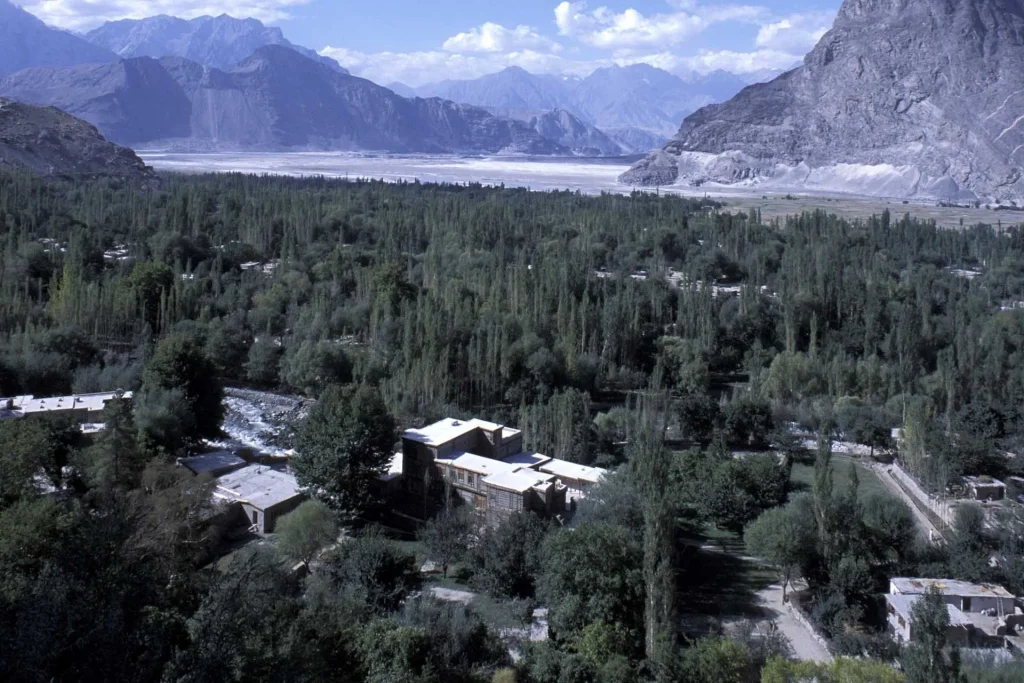
Tucked into the shadow of granitic cliffs where the Shigar River fans into orchards and poplar groves, Serena Shigar Fort is one of Pakistan’s most evocative heritage sites—part museum, part boutique hotel, and wholly a testament to Baltistan’s layered past. Known locally as Fong-Khar, or “Palace on the Rock,” the complex fuses centuries-old craftsmanship with a sensitive, modern re-use that keeps the building alive rather than entombed. Today, travelers find here not only a gateway to Skardu, Deosai, and even the Baltoro–K2 approaches, but a cultural crossroads where Balti traditions, Mughal-era influences, and contemporary conservation meet.
Setting the Scene: Shigar Valley’s Geography and Spirit
Serena Shigar Fort sits about 30 kilometers from Skardu, on the historic route that threads toward the highest reaches of the Karakoram. The valley’s climate, with stark winters and crystalline summers, has long shaped local building: thick stone walls for thermal mass, timber bands to flex under seismic shocks, and deep verandas that serve as social thresholds. From the fort’s terraces you can read the landscape like a text—the irrigation channels, the orchard plots, the track to the high pastures—and understand why a palace-fortress would choose this perch, half protected by the rock behind it and half displayed to the valley before it.

Origins: From Mountain Strongholds to Palace on a Rock
Shigar’s ruling Amacha line rose to prominence in medieval Baltistan, their power expressed first in cliff-top redoubts such as Khar-i-Dong (the “fort of the cliff”). Mughal campaigns in the 17th century reshaped the political map of the region, and the palace-fort we see today took form in this era, attributed to Raja Hassan Khan, the 20th ruler of the Amacha dynasty. Moving from an eagle’s-nest fort to a palace integrated with the valley floor signaled not only a change in tactics but in statecraft: protection remained essential, but display, diplomacy, and courtly life also mattered.
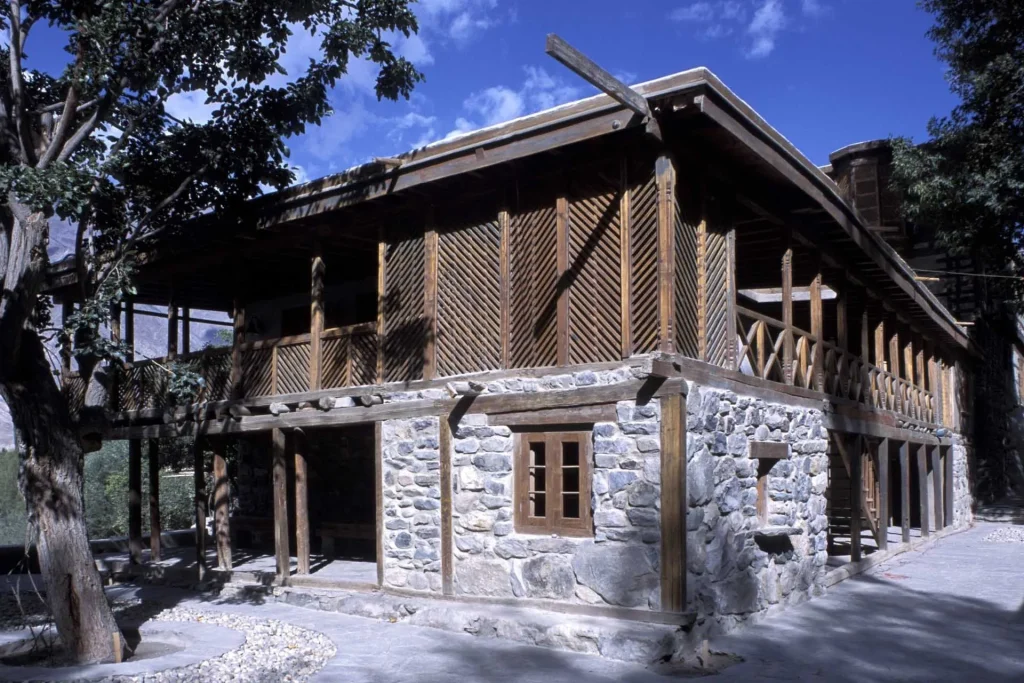
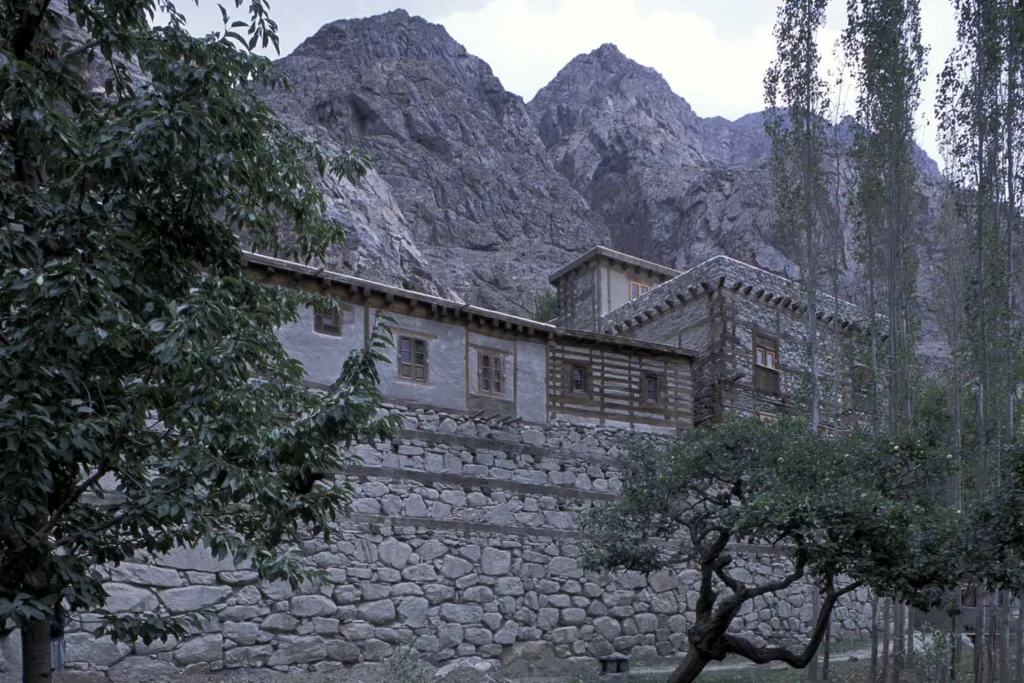
Locals’ name for the complex—Fong-Khar—captures its essence: built on rock, of rock, yet articulated with timber and mud plasters, it is both anchored and adaptable. Those material choices were practical responses to alpine conditions and seismic risk, but they also form the fort’s distinctive aesthetic: slate-grey stone courses cinched with honey-brown timber bands, carved balconies that float over courtyards, and stairways that turn corners like verses in a poem.

Architecture: Balti Craft, Transregional Influences
Shigar Fort’s architecture is a hybrid in the best sense. From Tibet and Ladakh come tiered massing, timber-laced walls, and latticework that filters light and wind. From Kashmir and Central Asia arrive carved soffits and calligraphic panels; from the Mughal idiom, a taste for axiality, symmetry, and carved jharokha-style balconies in elite chambers. Floors of polished walnut, heavy timber beams, and stone plinths impart both dignity and durability. These elements are not pastiche; they are the vocabulary of a borderland that has always brokered ideas along with goods.
The spatial sequence reveals how a palace doubled as a defensive refuge. Narrow, controlled entries bend attackers out of alignment; internal staircases tuck behind walls; terraces serve as both vantage and ventilation. Yet the private rooms—the baithak (sitting room), the royal bedchamber, and family courtyards—speak of ceremony and domesticity. In the evenings, when poplar leaves shiver and the stone absorbs the day’s last warmth, it’s easy to picture processions, adjudications, and winter storytelling by lamplight.
Decline and Renewal: From Ruin to Model Conservation
By the late 20th century, neglect and environment had taken a toll. The turning point came when the Aga Khan Cultural Service Pakistan (AKCSP)—part of the Aga Khan Historic Cities Programme—undertook a comprehensive conservation from 1999 to 2004. Rather than freezing the complex as a static relic, AKCSP followed a “conservation through use” model: stabilize what could be saved, reconstruct where evidence was sound, document interventions, and crucially, return the building to daily life as both a museum and a heritage hotel under Serena’s stewardship.
The results drew international recognition. In 2006, Shigar Fort received the UNESCO Asia-Pacific Heritage Award (Awards of Excellence cycle) for cultural heritage conservation. The project also earned a PATA Gold Award and a nod in Time magazine’s “Best of Asia” for revitalization—endorsements that underscored not only craftsmanship but the project’s broader social and economic ripple effects in a remote region.
What “Conservation Through Use” Looks Like on the Ground
Walk the complex today and you’ll see the philosophy in action. The royal suite remains legible as the Raja’s chambers—carved balcony, private terrace, and a baithak fit for receiving dignitaries—yet it functions as a guest room with discreet modern services. Other wings house interpretive exhibits—archival photos, ethnographic artifacts, tools, textiles—allowing non-staying visitors to understand the fort’s evolution. Restaurants and courtyards host meals, poetry readings, and community events, ensuring the space breathes beyond peak tourist hours.
Materially, the intervention privileged traditional techniques—timber dowels, lime plasters, local stone—supplemented with modern seismic reinforcement where essential. Craftspeople from the valley were trained and employed, transferring knowledge forward. The result avoids the “theme-park” gloss seen in some restorations; it feels authentic because it is, right down to the hairline irregularities of hand-made walls that catch morning light differently every day.
A Boutique Hotel Woven Into a Museum
As a 20-room heritage hotel wrapped around a museum core, Serena Shigar Fort offers an unusually intimate stay. Rooms are distributed among the historic palace, the Old House, and the Garden House. Expect handcrafted furniture, woven textiles, and floors that creak with honest timber rather than stage-set laminate. Dining emphasizes local produce—from valley vegetables to cherries transformed into a house ice cream that has become a minor legend among repeat guests. Evening meals under vine-latticed pergolas extend the architectural experience into taste and scent.
Because the hotel inhabits a fragile monument, services are quiet by design: lighting is soft, HVAC is carefully zoned, and pathways are scaled to people, not vehicles. Staff often double as informal interpreters of Balti custom, pointing out calligraphy, explaining the logic of timber-laced masonry, or suggesting a walk to a 14th-century mosque nearby. For those who come for alpine drama more than architecture, the property still functions as a restful base between treks.

The Museum Thread: Reading Shigar’s Story
Even if you’re not staying overnight, the museum component merits time. Exhibits trace Shigar’s political history—from the Amachas to Dogra incursions to modern administrative structures—while also foregrounding the slow, everyday arts that sustain mountain societies: weaving, woodcarving, irrigation management, seasonal transhumance. In juxtaposing royal regalia with homely tools, the curation resists romanticizing power and keeps the focus on the valley’s people.
Beyond the Walls: A Hub for the Upper Indus
Part of Shigar Fort’s appeal is its position as a hub for day trips:
- Skardu & Kharpocho (Skardu Fort): A 30–40 km drive links you to Skardu’s old quarter and the ridge-top Kharpocho Fort, a complementary study in defensive siting and Dogra-era overlays.
- Kachura Lakes (Upper & Lower): The mirror-like lakes west of Skardu offer boat rides and pine-framed walks—an easier, family-friendly excursion.
- Deosai National Park: In summer, the plateau’s tundra flowers, marmots, and occasional Himalayan brown bear sightings justify the bumpy approach.
- High Karakoram Access: For climbers, Shigar is the last substantial settlement on the jeep road toward the Baltoro, Concordia, and K2—the world’s second-highest peak—tying the palace to one of mountaineering’s most storied corridors.
Practicalities: When to Go and How to Approach
Season. The fort operates most comfortably from late spring to early autumn. Apricot and cherry blossoms tint the valley in April–May; July–September bring warmer days but also the possibility of monsoon-related disruptions on mountain roads and flights. By October, the poplars turn gold and the air sharpens. (Always check local advisories during the shoulder seasons.)
Getting there. Most visitors fly into Skardu (subject to weather) and drive roughly an hour to Shigar. Road travelers on the Karakoram Highway can branch to Skardu via the Skardu Road; allow extra time for construction or landslides. From Skardu town, taxis and hotel transfers are common.
Access for non-guests. Even if you’re not staying at the hotel, you can typically visit the museum areas and dine on-site; hours may vary, so confirm locally. The site’s popularity means midday can be busy—morning and late afternoon reward photographers with gentler light.
Culture and Etiquette: Meeting Baltistan on Its Own Terms
Baltistan is hospitable, but it’s also conservative in dress and custom. Within the fort, modest attire is appreciated; in village walks, always ask before photographing people. Many residents speak Urdu in addition to Balti; English is common among guides and hotel staff. Respect for religious spaces—mosques, shrines, cemeteries—goes without saying. If you’re invited into a home, accept tea; if you’re offered khurba (dried apricots) or butter tea, try a taste—the story of the valley’s adaptation to altitude runs through its cuisine.
Why Shigar Fort Matters: Heritage as a Living Resource
Shigar Fort’s restoration is often cited in conservation circles because it threads a needle many projects miss. First, it balances authenticity with usability: rooms remain proportioned as they were, woodwork is repaired rather than replaced wholesale, and modern comforts are integrated with minimal intrusion. Second, it anchors local livelihoods—craft training, steady employment, and secondary spending by visitors—which makes the case for keeping heritage intact not just for memory, but for money and dignity. Third, it foregrounds regional identity in a nation where lowland narratives can easily overshadow mountain cultures.
This approach has become a template within and beyond Gilgit-Baltistan, with related projects at Baltit, Altit, and Khaplu demonstrating that conservation can be both rigorous and economically generative. In recognizing Shigar, international bodies weren’t only praising a photogenic restoration; they were endorsing a development model that scales.

A Day Inside the Fort: Suggested Slow Itinerary
Morning: Enter through the lower gate as the sun clears the ridge. Linger in the first courtyard to understand how circulation works—note the timber struts, the small doors within larger gates, the asymmetry that confuses attackers but feels natural to residents. Climb to the royal terrace; look south across orchards to the river, and north to the rock that shelters the palace. Then duck indoors to read wall panels and trace the Amacha genealogy.
Midday: Break for lunch at the Baltistan Restaurant—light, local plates travel well at altitude. If available, order chapshuro or a seasonal vegetable stew, and save room for the house cherry ice cream, made with fruit from the property’s own trees.
Afternoon: Visit the museum rooms focused on craft and conservation; look for the joinery details that reveal how old meets new—steel discreetly nested inside timber, for instance, or lime plasters that breathe in a way cement never can. Stroll the gardens; the geometry of irrigation channels echoes the order inside the palace, a reminder that water management and governance were once inseparable.
Evening: If you’re staying overnight, watch blue hour gather in the courtyards. The stone goes cool, swallows loop under eaves, and lamps mark thresholds with amber halos. If you’re not staying, step out to the village lanes and listen: dogs bark, prayer murmurs rise, and the river keeps its steady bass line.
Responsible Travel Tips
- Support local enterprise. Buy crafts in nearby markets, especially handwoven textiles and carved wood items.
- Tread lightly. The building is robust but old; stick to paths, avoid leaning on carved balustrades, and follow staff guidance on no-go areas.
- Mind altitude and weather. Hydrate, layer clothing, and plan conservatively if you’re heading on to Deosai or the Baltoro road.
- Learn a word or two. A simple “Jullay” (a common Ladakhi greeting also understood in parts of Baltistan) or a few phrases of Urdu go a long way.
The Fort in the Wider Conservation Conversation
Shigar’s accolades matter because awards shape funding and policy. The UNESCO Asia-Pacific Heritage Award (2006) validated the project’s method in a region often overlooked by global institutions; PATA and Time awards amplified the tourism-development link. While the latest cycles of the Aga Khan Award for Architecture have honored new projects elsewhere, Shigar’s restoration remains a frequently cited case study in program literature and conservation forums—proof that a carefully stewarded monument can catalyze regional renewal. (Aga Khan Development Network, Architectural Record, WorldArchitects)

Final Thoughts: A Fort That Still Works
Some monuments end up embalmed—perfected, polished, and lifeless. Serena Shigar Fort is different. It has been restored to work: as a building, as an archive, as an employer, as a host. The stones carry their weathering proudly; the timber smells faintly of resin; the rooms are scaled for people, not Instagram. You can learn a lot about Baltistan’s past here, but you can also learn something hopeful about its future—that heritage, when trusted and tended, can be a living asset rather than a nostalgic burden.
Whether you’re a mountaineer chasing the shadows of K2, a student of architecture tracing seismic wisdom in timber bands, or a traveler content to sit under a vine trellis and hear the river, Shigar Fort rewards attention. It stands for a way of building—and rebuilding—that binds memory to use, beauty to livelihood, and a kingdom’s old palace to a community’s present life. (Serena Hotels, Aga Khan Development Network)
