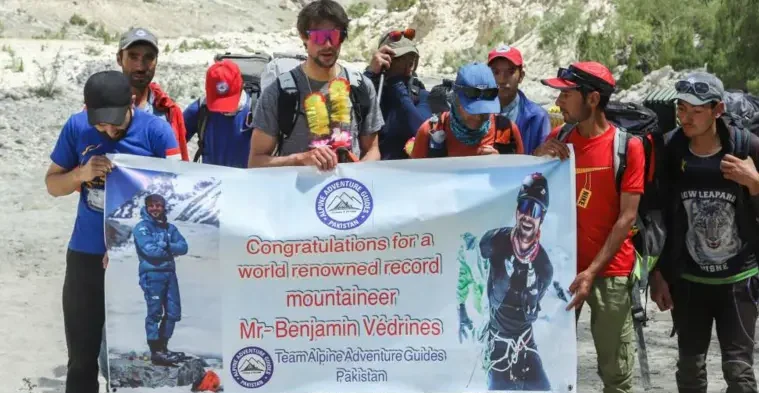
Zubair Khan Journalist
August 2024
“I was left in awe looking at K2. It felt as though it was calling me, summoning me, so I decided I had to climb it.”
When 32-year-old French mountaineer Benjamin Vedrines answered this “calling” and resolved to conquer K2, the world’s second-highest mountain, even he might not have known that during this endeavor, he would not only face a life-and-death struggle but also achieve the feat so swiftly that it would set a new record.
Benjamin shocked the world by summiting K2 in just 10 hours, 59 minutes, and 59 seconds. Previously, the record for climbing one of the world’s most dangerous peaks in the shortest time belonged to his compatriot, Benoît Chamoux, who had achieved the feat in 23 hours back in 1986, 38 years ago.
General Secretary of the Alpine Club of Pakistan, Karrar Haidri, remarked that it took four decades to break the 23-hour record for climbing K2. “It was expected that the record might be broken by a few minutes or perhaps an hour or two, but here we are seeing a difference of almost 11 hours. Benjamin Vedrines has shattered his compatriot’s record in less than half the time.
According to Karrar Haidri, the speed record set by Vedrines appears to be difficult to break in the foreseeable future.
Benjamin Vedrines identifies himself as an “alpinist,” meaning a mountaineer who climbs glaciated peaks. Throughout his climbing career, Vedrines has summited only two peaks above 8,000 meters, yet his passion for speed climbing has enabled him to set records on both occasions.
He has summited Broad Peak twice and has now reached the summit of K2 on his second attempt. Two years ago, he set a record by climbing Broad Peak, the world’s 12th highest mountain, in just 7 hours and 28 minutes. This record was achieved with a significant time difference of 7.5 hours, as the previous record was held by Swedish mountaineer Göran Kropp, who summited the peak in 15 hours back in 1994.

For Benjamin Vedrines, the journey of his love for mountains was neither easy nor did success come effortlessly. During his first expedition to K2, he faced a life-and-death struggle.
Speaking to me, he said, “I have been in love with mountains since childhood. I always wanted to do something different. When I grew older, I trained in mountaineering and became a mountain guide. Eventually, my interest shifted to being an alpinist, so I climbed several glaciated peaks.
“The Himalayas and Karakoram have always called to me. Two years ago, I came to Gilgit-Baltistan to summit Broad Peak. It wasn’t about setting a record or chasing recognition; I simply wanted to do something different. I gave it my all, stayed focused, and ended up breaking the speed record on Broad Peak. After reaching the summit, I even paraglided from there.”
Benjamin further shared, “The mountains of the Himalayas and Karakoram completely captivated me. A few days after summiting Broad Peak, I went to see K2. When I saw it, I was mesmerized. It felt as though it was calling to me, summoning me. That’s when I decided I had to climb K2.
Thank God I came back alive
Benjamin had only recently summited Broad Peak in 2022 when he set off on his K2 expedition.
“I was exhausted, my body wasn’t prepared, and perhaps I wasn’t mentally ready either. I had no proper information, nor had I sought expert advice, but at that moment, I felt that K2 was calling me. Its grandeur had captivated me.”
K2, while evoking a sense of “adventure” or exploration in the hearts of mountaineers who conquer towering peaks, is also considered more terrifying than the world’s highest peak, Everest. The fatality rate on K2 is 29%, with one out of every four climbers aiming to summit this peak losing their life. In contrast, Everest has a fatality rate of just 4%.
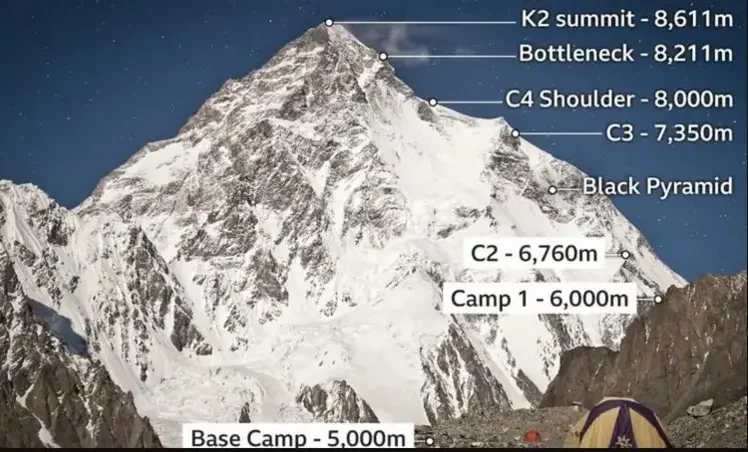
According to the French mountaineer, his journey from Base Camp to Camp Four went well, but at the “Bottle Neck,” his condition deteriorated.
At 8,611 meters above sea level, K2’s “Bottle Neck” is a region that starts at around 8,000 meters and is known as the “Death Zone” in mountaineering terminology. Here, climbers must fight not only the deadly natural elements but also their own bodies.
In the Death Zone, a single misstep can result in falling into a deep crevasse or glacier, leading directly to death. Additionally, the further lack of oxygen at this altitude has severe effects, causing the human brain to lose control over the body, leading to paralysis.
Benjamin shared, “Everything was going well, but when I reached the Bottle Neck, I became ill. I couldn’t understand what was happening. I couldn’t remember where I was or what I was doing.”
According to him, “At that moment, there was only one thought: that when I was just a few hundred meters away, I should keep going upwards, but my body and mind weren’t cooperating. My brain wasn’t getting enough oxygen. Those moments were dangerous—extremely dangerous. But I was mentally very strong, and my spirit was still alive.”
“At that point, a few friends helped me by advising me not to go further up from the Bottle Neck. It was these same friends who assisted me in descending. They first took me to Camp Four, where my body was warmed up, and then brought me down through Camps Three, Two, and finally Base Camp, where I started to feel better.”
Benjamin shared that what happened to him at the Bottle Neck was extremely dangerous, and he is grateful to have returned alive.
The day Benjamin had to abandon his K2 summit attempt was July 28. He said, “That date became etched in my heart and mind,” and two years later, on the same date, he achieved the remarkable feat of summiting K2 in the shortest time ever.
I didn’t summit Nanga Parbat for the sake of a friend.
After his incomplete expedition on K2, Benjamin returned to France, but he says, “I felt like the Himalayas and Karakoram were calling me, I had fallen in love with K2.”
He explains, “At that time, I was advised, and I also thought that while I may not go to K2 right now, I definitely had to go to the Himalayas and Karakoram. So, I decided to head towards Nanga Parbat, the world’s ninth-highest peak at 8,126 meters.”
“I thought about summiting Nanga Parbat because I needed to summit K2 with speed, and going there without preparation would be dangerous. The accident from a year ago was still fresh, and the Nanga Parbat expedition could help me prepare for K2.”
Benjamin adds that the Nanga Parbat expedition was an alpine-style adventure, where mountaineers carry minimal equipment, oxygen, and food, and they use ropes only sparingly or not at all.
“Everything was going well on Nanga Parbat. I had reached above 7,000 meters when one of my fellow climbers became extremely exhausted. His condition had worsened, and it was no longer possible for him to continue further up.”
He explains that although he could have reached the summit of Nanga Parbat, he abandoned his expedition there, seeing his friend’s life in danger, and descended with his companion.
“I felt like the summit was within reach, but I couldn’t be selfish. My friend’s life was at risk. So, I decided that this expedition would end here, but I would return to it later. After all, this expedition was for preparing for K2. I felt I was ready for K2, and at that moment, saving my friend’s life was more important.”
“When I saw K2, I said, ‘I’m here.'”
According to the French mountaineer, after setting a record on Broad Peak and the unsuccessful K2 expedition, he started preparing again for an expedition to the world’s second-highest mountain. “I began physical and mental training to prepare my body. For mountaineering, especially for a mountain like K2, and then to summit it at speed, it is essential not only to be physically strong but also mentally resilient.”
“I trained physically and mentally for 20 to 22 hours a week. Even after returning from Nanga Parbat, I continued with the same training. A year later, the time came, and I reached K2 again. When I saw it, I said, ‘I’m here.’ I felt like K2 was calling me, saying, ‘Come, I’ve been waiting for you.'”
Benjamin recalls that when he arrived at K2, there were many challenges. “There was strong wind, and the weather kept changing. Many climbers were delaying their expeditions for a while.”
Unlike those climbers, Benjamin decided to move forward. “I started my journey at midnight. I had no porter, companion, or helper with me. I was walking alone on the white snow at night. No other climbers were around. At that moment, my spirit was at its peak, and my strength was high. All eyes were on me because everyone knew I wanted to complete the expedition at speed.”
According to the French climber, he used the traditional route and relied on the ropes already installed on the mountain.
“I didn’t stop at Camp One at all. Maybe just a few seconds at Camp Two. I stopped for a while at Camp Three and spent more time at Camp Four. During this time, I was using warm water to drink.”
It’s important to note that Camp One of K2 is at 6,000 meters, Camp Two at 6,760 meters, Camp Three at 7,350 meters, and Camp Four at 8,000 meters.
Benjamin says, “At that moment, I wasn’t thinking about how much time I was taking or how much time it should take, I was just moving quickly.”
He recalls that after spending some time at Camp Four, when he moved forward, he encountered the “Bottle Neck.”
“I kept moving and passed through the Bottle Neck, forgetting that two years ago, I was fighting for my life at this very spot. All I remembered was that K2 was calling me, and I had reached it.”
