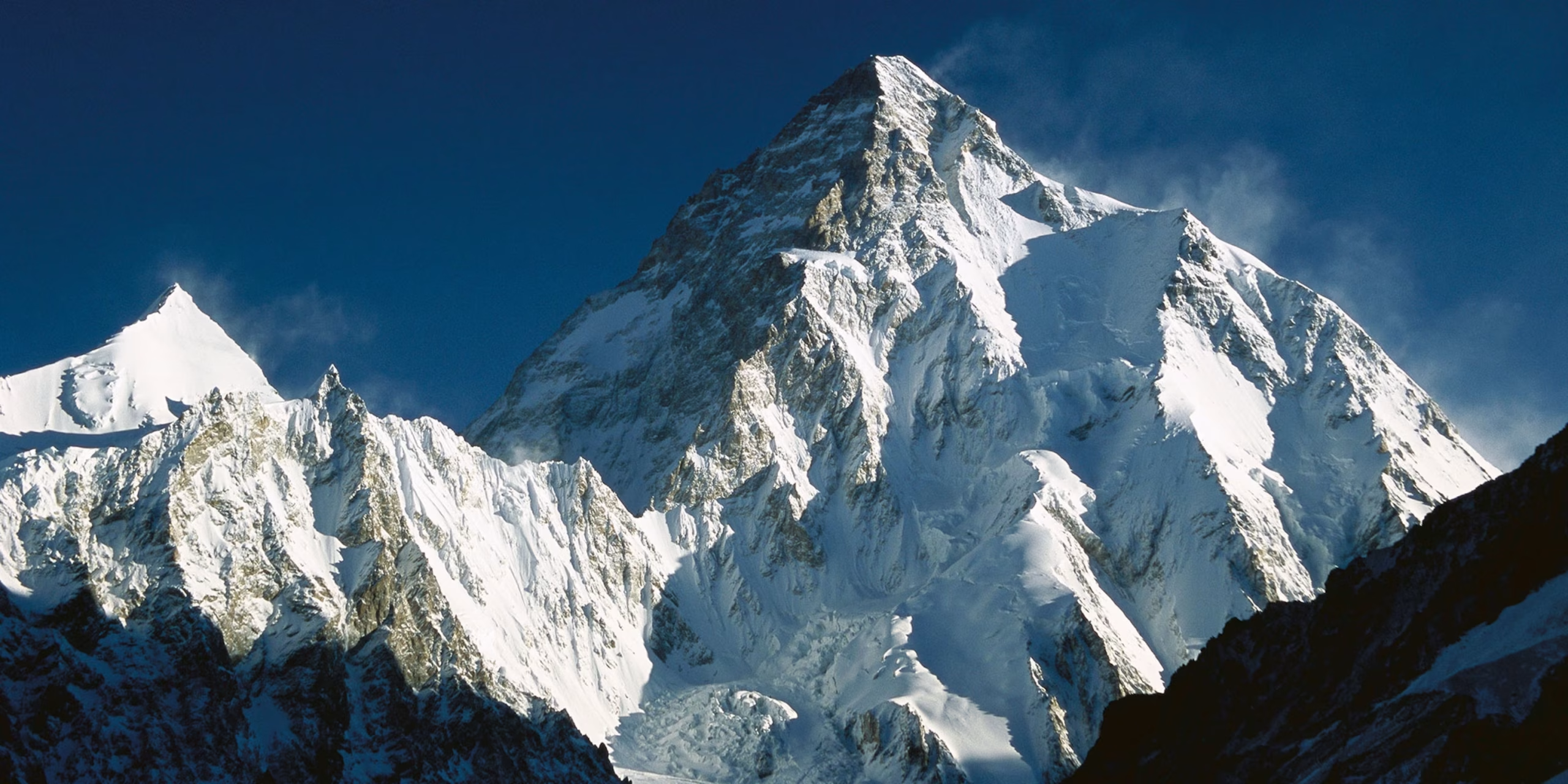
K2 Mountain: The World’s Second-Highest Peak
K2, located in the Karakoram Range of the Himalayas, is the second-highest mountain on Earth, standing at an elevation of 8,611 meters (28,251 feet). While Mount Everest takes the top spot as the highest peak, K2 is often regarded as one of the most difficult and dangerous mountains to climb. Known for its treacherous terrain, unpredictable weather, and challenging conditions, K2 has earned a fearsome reputation among mountaineers.
The Geography of K2
K2 is located on the border between Pakistan and China. It lies in the northern part of the Karakoram range, which spans parts of Pakistan, India, and China. The mountain’s peak forms part of the larger complex of high-altitude peaks that includes some of the most prominent and difficult climbs in the world.
K2 is also known by its local name, Mount Godwin-Austen, named after the British surveyor Henry Godwin-Austen, who first surveyed the mountain in the 19th century. While the name “K2” is derived from the notation used by the Great Trigonometric Survey of India, where it was labeled as the second peak in the Karakoram range.
Climbing K2: The Challenges
While K2’s height makes it one of the tallest mountains in the world, its technical difficulty and the dangers it presents to climbers make it notoriously challenging. Compared to Mount Everest, which is often described as a “walk-up” for those with enough acclimatization, K2 requires a higher level of technical climbing skill, endurance, and mental fortitude.
One of the primary challenges of K2 is its steep slopes. The mountain has a significantly more rugged and difficult ascent compared to Everest, with many sections requiring advanced rock climbing, ice climbing, and navigating steep, unstable ridges. The mountain is also known for its sheer rock faces and unstable weather conditions, which can change rapidly and become deadly.
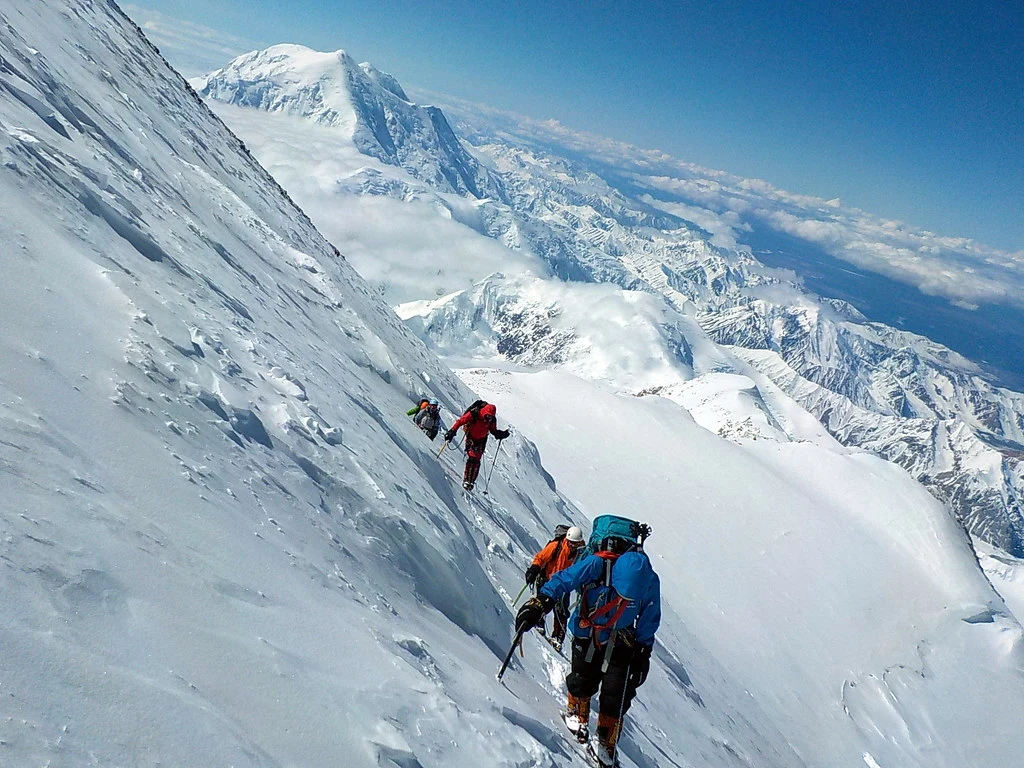
The “Death Zone” on K2, like Everest, refers to altitudes above 8,000 meters where the oxygen levels are insufficient for human survival, causing climbers to suffer from severe altitude sickness, fatigue, and dehydration. The altitude combined with extreme cold temperatures, avalanches, and the risk of falling rocks increases the danger exponentially.
Climbing History
The first successful ascent of K2 was made on July 31, 1954, by an Italian expedition led by Ardito Desio. The summit was reached by Achille Compagnoni and Lino Lacedelli, marking a historic achievement. However, the climb was not without controversy, as some expedition members believed that the final push to the summit was achieved under dangerous and questionable circumstances.
Since then, numerous expeditions have attempted to summit K2, but many have faced tragic outcomes. Due to the harsh conditions, the mountain has claimed many lives, and K2’s fatality rate is among the highest for any peak above 8,000 meters. The extreme technical difficulty of the climb, combined with the unpredictability of the weather and avalanches, makes it a highly dangerous undertaking.
K2’s Reputation for Danger
The difficulty of K2 is reflected in its climbing statistics. It has a significantly higher fatality rate than Mount Everest, with estimates suggesting that one in four climbers who attempt K2 do not return alive. One of the most dangerous aspects of K2 is its weather conditions, which are known for being unforgiving. Winds can reach speeds of over 100 miles per hour, and snowstorms can descend without warning.
In addition, many parts of the climb are exposed to the risk of avalanches, particularly during the summer and early autumn seasons when temperatures fluctuate and snow conditions change. The mountain’s steep faces and technical challenges make rescue operations extremely difficult, further increasing the risks for climbers.
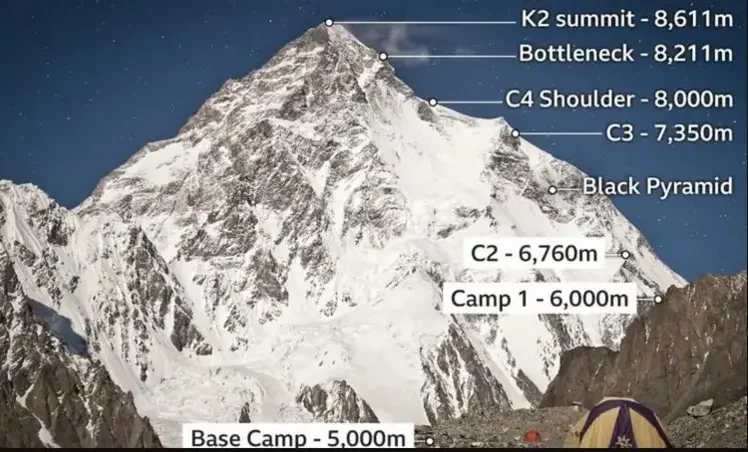
The Trek to K2: Base Camps and Routes
Climbers typically approach K2 from two primary routes: the Abruzzi Spur, the most popular and traditionally used route, and the Cesen Route, which is a slightly more technical but less used path. Both routes start at the K2 Base Camp, located on the Pakistani side of the mountain. The trek to the base camp itself is a strenuous journey, with hikers often needing to cross glaciers, navigate rocky terrain, and endure extreme conditions.
The K2 Base Camp is situated at an elevation of about 5,150 meters (16,896 feet), and climbers use this as a staging area for further ascents. From here, they make multiple ascents, gradually acclimatizing to the thin air before attempting the summit. Along the way, there are several camps set up to provide shelter and supplies, but these camps can often be isolated and exposed to the elements.
K2’s Importance in Mountaineering Culture
K2 has long been regarded as one of the ultimate challenges in mountaineering. It is often considered by climbers to be a more prestigious and difficult ascent than Everest, and as a result, it draws some of the most experienced and skilled mountaineers in the world.
Despite its dangers, K2 continues to attract climbers year after year, as the allure of summiting one of the most difficult mountains in the world is incredibly powerful. For many, the mountain represents the pinnacle of climbing achievement.
K2 and Conservation
While K2 may be known for its deadly peaks, it is also part of an incredibly beautiful and remote part of the world. The surrounding Karakoram range is a paradise for naturalists, with unique landscapes, glaciers, and wildlife. Conservation efforts in the region aim to protect both the natural environment and the indigenous cultures of the area.
In recent years, the region has also faced growing concerns over the effects of climate change. As glaciers retreat and weather patterns become more unpredictable, the environment around K2 and other high-altitude regions is rapidly changing, presenting new challenges for future expeditions.
Read More Related K2 Mountain
How much does it cost to summit K2
K2 Summit Expedition For International Climbers
What is K2’s “Death Zone,” and how many hours can climbers survive there?
How can american climber submit k2 Mountain
