“Surjung Glacier”: The Beauty of Gilgit-Baltistan that is Now ‘Terrifying’ the Locals
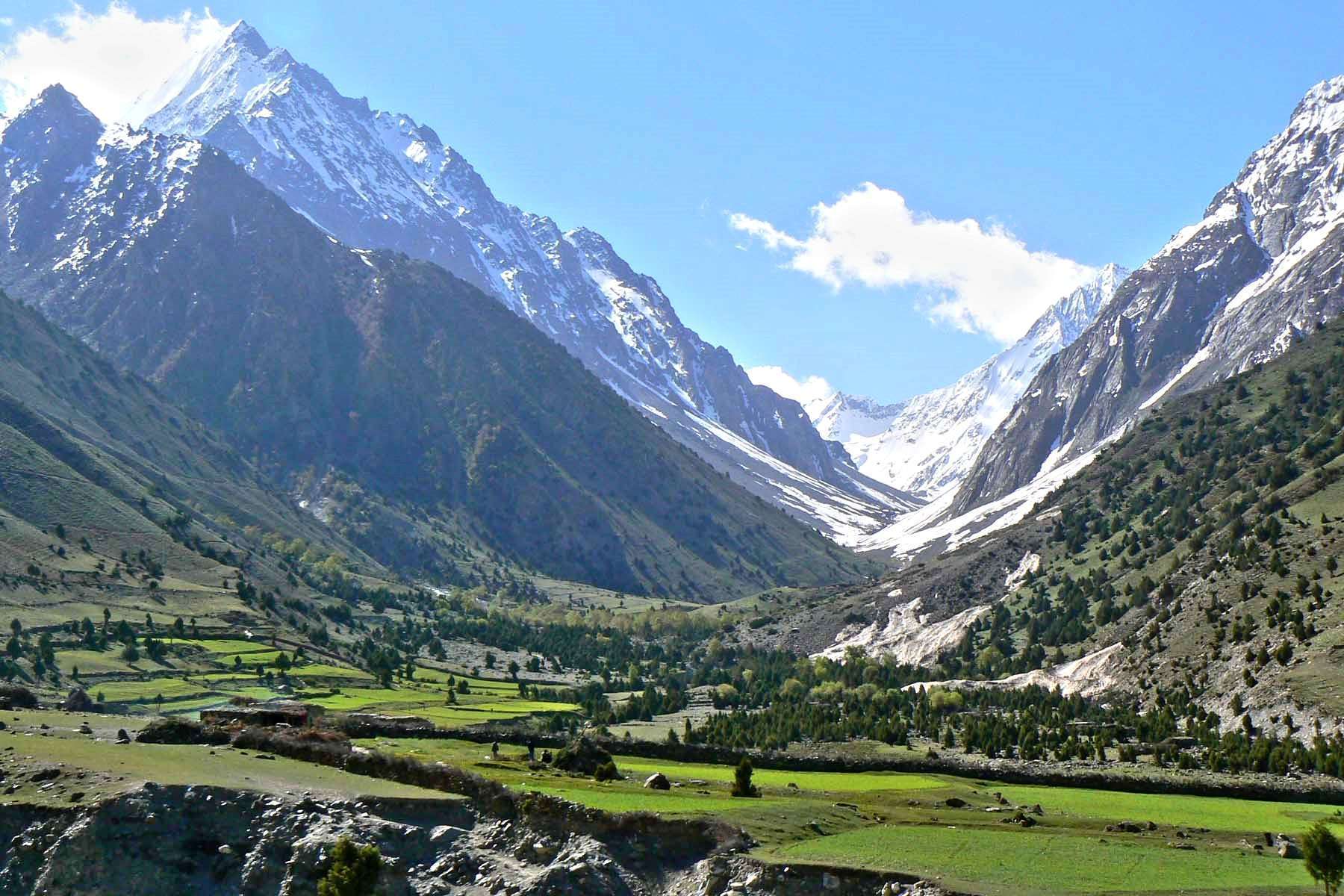
Upon reaching here, the first impression you get is that this is the perfect place to live. From a distance, snow-covered peaks begin to appear, and beneath them stretches lush greenery, with rivers winding their way between them, carving their own path.
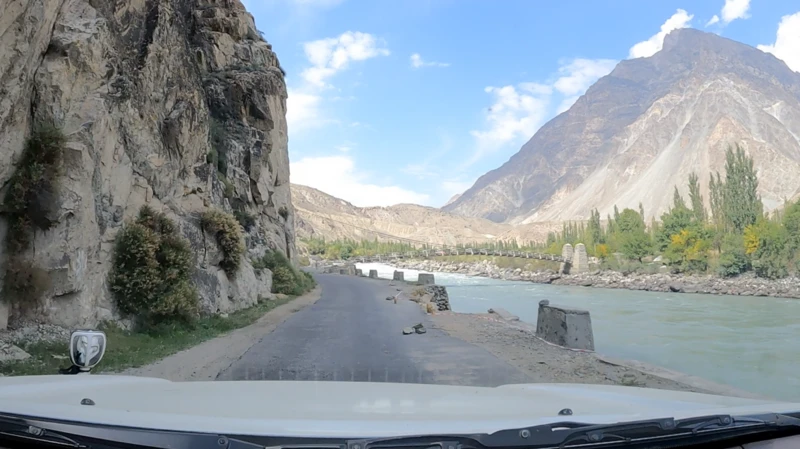
I am in the Ghizer district of Gilgit-Baltistan, in the Yasin region, and this is the Darqut valley. The unpaved road winds through rows of poplar trees, crossing a long wooden suspension bridge, and then it abruptly ends.
My gaze falls on the two glaciers high up on the mountains, hovering above the Darqut valley. They seem to be suspended, as if they’re about to slip and come crashing down any moment. I am heading towards these glaciers. After crossing the bridge, the vehicle slows down, and it begins to bounce over the small and large stones.
Just a few days ago, a flood passed through here, and these stones were brought by the floodwaters. We emerge from the stony path and return to a dirt road that leads upward. On the left side, the ruins of some houses stand, and on the right, high up, there is a tent set up.
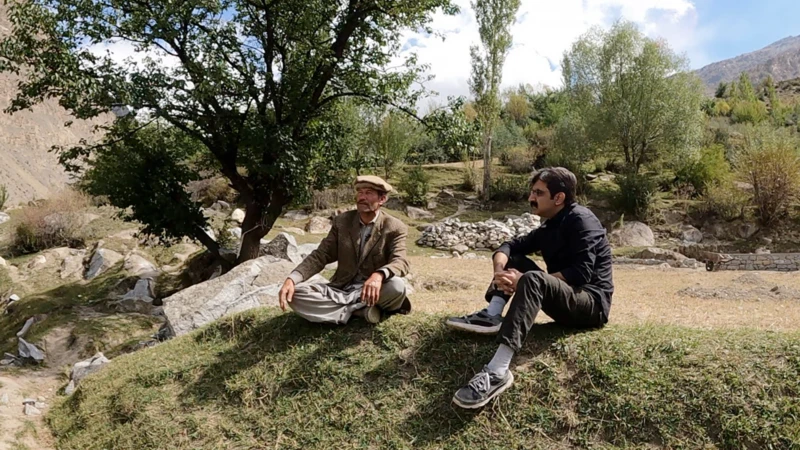
Next to the tent, there’s a small, partially constructed house, and two laborers are working on it. I stopped, and here I met Ashraf Khan. He is 58 years old and wearing the traditional Gilgiti cap. This damaged house belongs to him; it was affected by the recent flood.
Now, he is building two rooms on a slightly higher ground, which he must complete before the coming winter; otherwise, it will be difficult to endure the severe cold of Darqut in a tent. Standing next to his tent, one can see the entire Darqut valley below. Beyond his house, along the road, is the area where the recent floodwaters had passed.
This time, the water had breached the protective wall built by a non-governmental organization some time ago, which had been intended to protect the settlement from floods.
Further ahead, there is an open field stretching over a large area, showing the debris of past floods, with poplar trees sunken within it. But beyond this field, the greenery begins, extending all the way to the foothills of the distant mountains. In the middle, there’s a small settlement, and beyond that are the glaciers I need to reach.
From here, the view is so beautiful that even the unsightly scars left by the flood debris on the landscape don’t seem too bad. There is peace, freshness, and beauty, along with the material things necessary for life.
Ashraf Khan told me that the people here practice farming. The recent flood had destroyed their potato crop. People also make a living by raising livestock, and there used to be a wood carving industry here—perhaps one could say, there used to be.
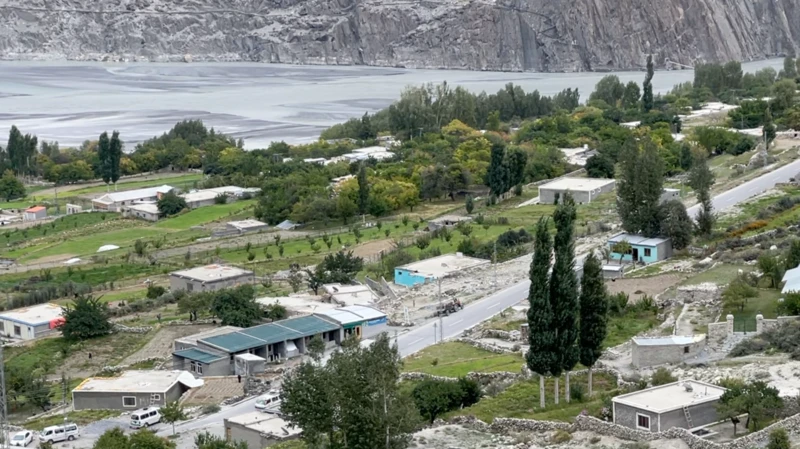
Who wouldn’t want to visit this beautiful valley?
Ashraf Khan says that in recent years, dozens of families have left Darqut. “The first major flood occurred here in 1978. After that, many people moved towards Gilgit because their homes and land were destroyed.”
Even after that, there were periodic floods, and in the following years, many people continued to migrate from Darqut. But Ashraf Khan explains that since 2010, almost every year, floods coming from the mountains during the summer have targeted Darqut.
In these floods, dozens of people lost their lives due to water and landslides, while many families lost their livelihoods when the flood debris rendered their lands infertile and uninhabitable.
Standing next to his tent and pointing down towards the valley, Ashraf Khan explained, “First, the flood came to this part in front, so people built their homes on the other side, but the next year, those homes were also washed away. Then people moved even further ahead and built new homes, but the following year, they too were destroyed. After that, they left this village altogether.”
Ashraf Khan adds that some people who once owned substantial land here are now forced to work in Gilgit city. “Now, the opportunities to earn here are becoming very limited. Every year, in the summer, we don’t even know if our homes will survive or not.”
“Why do so many floods occur here?”
Ashraf Khan doesn’t have a definitive answer to why so many floods occur, but he knows that over the past several years, the heat has been increasing, and there’s less snowfall on the mountains. “When there’s less snow, glaciers melt. When there’s snow, the snow melts but the glaciers don’t,” Ashraf Khan explains. That’s all he knows about the issue.
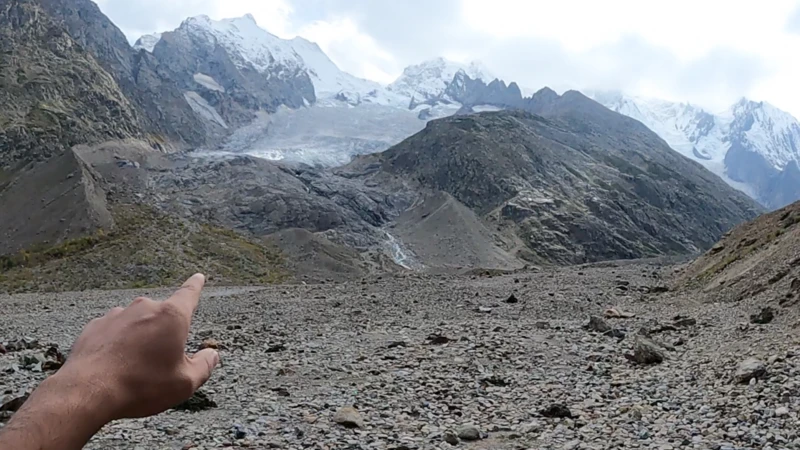
Pointing towards one of the two glaciers visible ahead, he mentions that the glacier’s mouth or snout used to extend much further down. Now, it has melted and receded, moving several meters higher up. “Beneath this glacier, there is a very large lake. It used to be much smaller. When we were young, the fruit carried down by the glacier’s water would fall into the lake, and we would collect and eat them.”
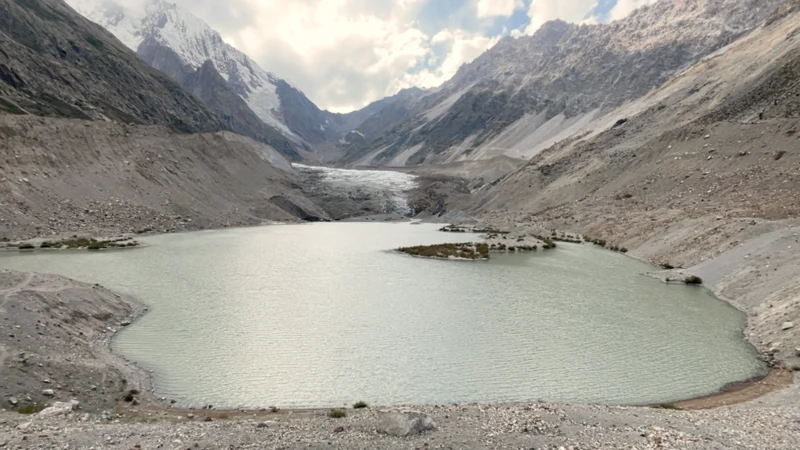
But now, the lake has become so large that a few years ago, Ashraf Khan’s cousin fell into it and drowned. He adds that they don’t have the resources to migrate from Darqut, and they don’t even know why there is less snow, which is causing the glaciers to melt and leading to floods.
Ashraf Khan then explained the path I needed to take to reach the lake and the glaciers above it, which were visible from here. It took me nearly an hour to reach that point on foot.
“Is it only the future of the people of Darqut that is at risk?”
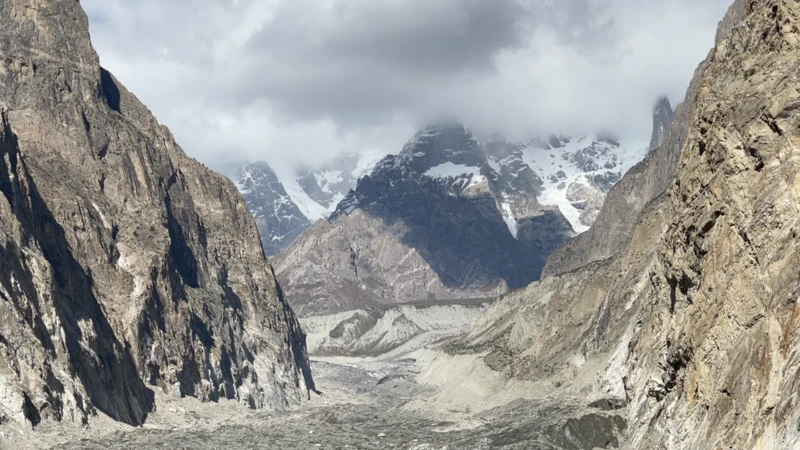
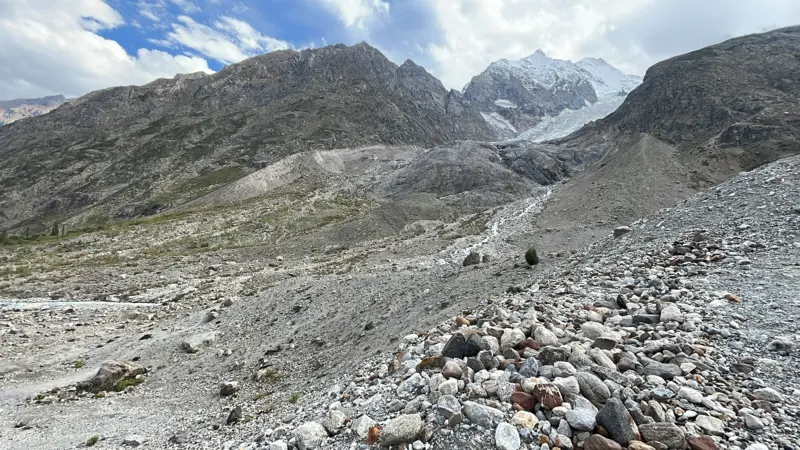
I am standing right above the lake. Clearly visible in front of me are two glaciers that once likely met lower down, but now they have retreated far back.
One of the glaciers has created a lake below it. During the summer and monsoon seasons, this lake must fill up rapidly, and there is a real risk of flooding. The water from the flood would flow down to the valley, where it meets several streams coming from both sides, forming a small river that then moves toward the lower regions.
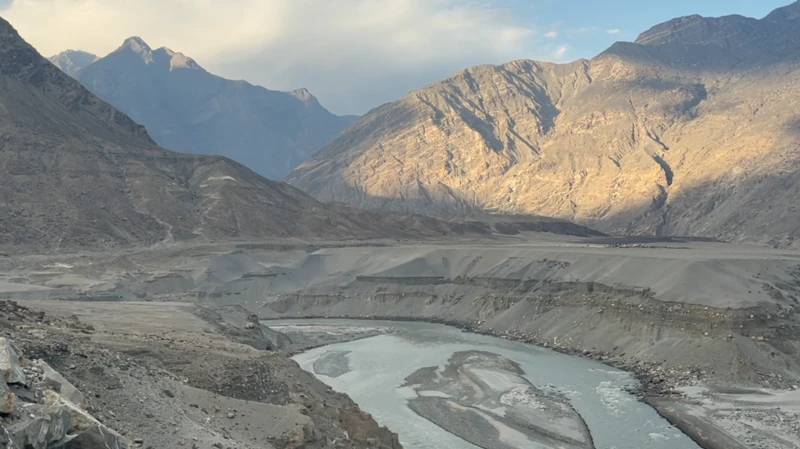
As this river travels for miles, it continues to merge with smaller rivers, growing larger and larger until it eventually joins the mighty Indus River just beyond Gilgit city. This entire western region of the Hindu Kush, Himalayas, and Karakoram is part of the Indus River’s catchment area.
In other words, every glacier that melts, every glacial flood, and every rainfall in this entire area contributes to the water flow that eventually reaches the Indus River. From there, the water flows southward across Pakistan, all the way to the Arabian Sea. The more water there is from floods upstream, the greater the risk of damage downstream.
Therefore, the floods that occur in areas like Darqut are not just a problem for the people of Darqut alone.
What is it that Ashraf Khan does not understand?
Dr. Zia Hashmi is an expert in glaciology at the Global Change Impact Studies Centre in Islamabad. Speaking to me, he explained that due to global warming, glaciers in Pakistan have been melting at a much faster rate in recent years.
So, what Ashraf Khan doesn’t understand is global warming or climate change. But what is it exactly? Dr. Zia Hashmi gives a simple answer: the Earth’s temperature has risen significantly over the past century. Even a one-degree change in temperature is enough to greatly accelerate the rate at which glaciers melt. And the rise in temperature is largely driven by human activity. Increased industrialization, more vehicles, the burning of fossil fuels, and large-scale deforestation to make way for urbanization are considered the main causes behind this rise in temperature
How is this affecting the glaciers?
Dr. Zia Hashmi explains: “Due to global warming, temperatures are rising, and as temperatures increase, the lower layers of glaciers begin to melt. When these layers melt, it causes the glacier to move. It shifts from its position. This type of glacier is called a surging glacier. The movement of glaciers like this also leads to glacial lake outburst floods (GLOFs).”
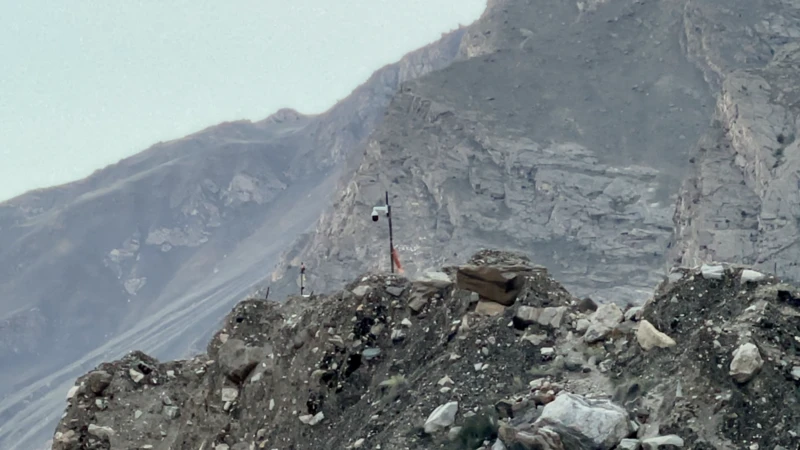
The rapid melting of glaciers and the subsequent floods in the form of GLOFs are flash floods that strike swiftly, particularly affecting the communities living in the mountainous regions. A similar GLOF occurred in 2022 in the Hassanabad area of Hunza. This flood originated from the Shishper Glacier, which is located several kilometers up in the Shishper Valley.
After leaving Darqut, I headed in that direction. I wanted to understand what a GLOF really is and why the people living in these mountains are so terrified of it. Upon reaching Hassanabad, I saw that a massive, sturdy bridge that used to connect the rest of Pakistan to Hunza and, beyond that, to China had been destroyed by the flood from Shishper Glacier. The water had come down with such intensity and speed that it completely wiped out the bridge.
Why is a glacial flood dangerous?
Here, I met Tariq Jamil, a social worker who has been working on issues like GLOFs (glacial lake outburst floods) for several years. He explained that the Shishper Glacier had essentially blocked the water of another glacier higher up in the valley. In the summer, the water from the blocked glacier flows down rapidly, forming a lake. When this lake bursts, it causes a flood.
We decided to visit this site. We had to walk for about three hours over the Shishper Glacier to reach the place where the lake was located. I was standing right on top of the lake. In the distance to the west, there was another glacier, with its water flowing toward Shishper. But to reach this water, there was a small path under a several-foot-high black ice mountain.
When this path was blocked, and the water flow from the adjacent glacier increased in summer, a lake formed at this location. Tariq Jamil explained that “the lake’s volume was several cubic feet in height, and when it emptied, it took about 70 hours for all of it to drain.”
“Previously, it took longer for the lake to drain. This time, it emptied more quickly, meaning the glacier had melted more, which caused the mouth of the lake to widen. This allowed the water to flow more easily, and as a result, the flood downstream caused massive destruction. This is also why the Hassanabad bridge collapsed.”
Dr. Zia Hashmi, a glaciologist, agrees and explains that Shishper is also a surging glacier. “The movement of the glacier caused it to move down and block the water flow of the adjacent glacier, forming a lake. When the lake burst, it caused a GLOF (glacial lake outburst flood), or a glacial flood.”
How much of a role does Pakistan play in global temperature rise?
Dr. Zia Hashmi believes that Pakistan’s contribution to global warming, or the increase in Earth’s temperature, is very small or almost negligible. However, Pakistan is one of the five countries most affected by global warming or climate change.
“This has mostly been caused by developed countries, where the rate of fuel consumption is very high, and the harmful carbon emissions from this are warming the planet,” he explains.
The question then arises: if Pakistan has little to no role in global warming, its ability to stop it may also be limited, and this makes it harder for Pakistan to mitigate the negative impacts it is experiencing.
So what should Pakistan do?
Experts say that it is possible for Pakistan to adapt to the effects of climate change, meaning it can take measures to prevent the damage caused by climate change. And Pakistan had ample time to prepare for this. The floods of 2010 and several other natural disasters that followed had already warned the country.
The 2022 floods have once again raised the question: Has Pakistan adequately prepared over the years to mitigate the negative impacts of climate change? Could better safety measures and management have prevented the damage caused by this flood?
In this series of stories, I am traveling from Pakistan’s northern regions southward along the Indus River, exploring whether the devastation caused by the 2022 floods was more due to climate change or government mismanagement. Did more water flow into the Indus River from here, or was there an absence of proper management systems to handle the water effectively? My next stop will be the province of Khyber Pakhtunkhwa, where flash floods caused significant destruction.
